


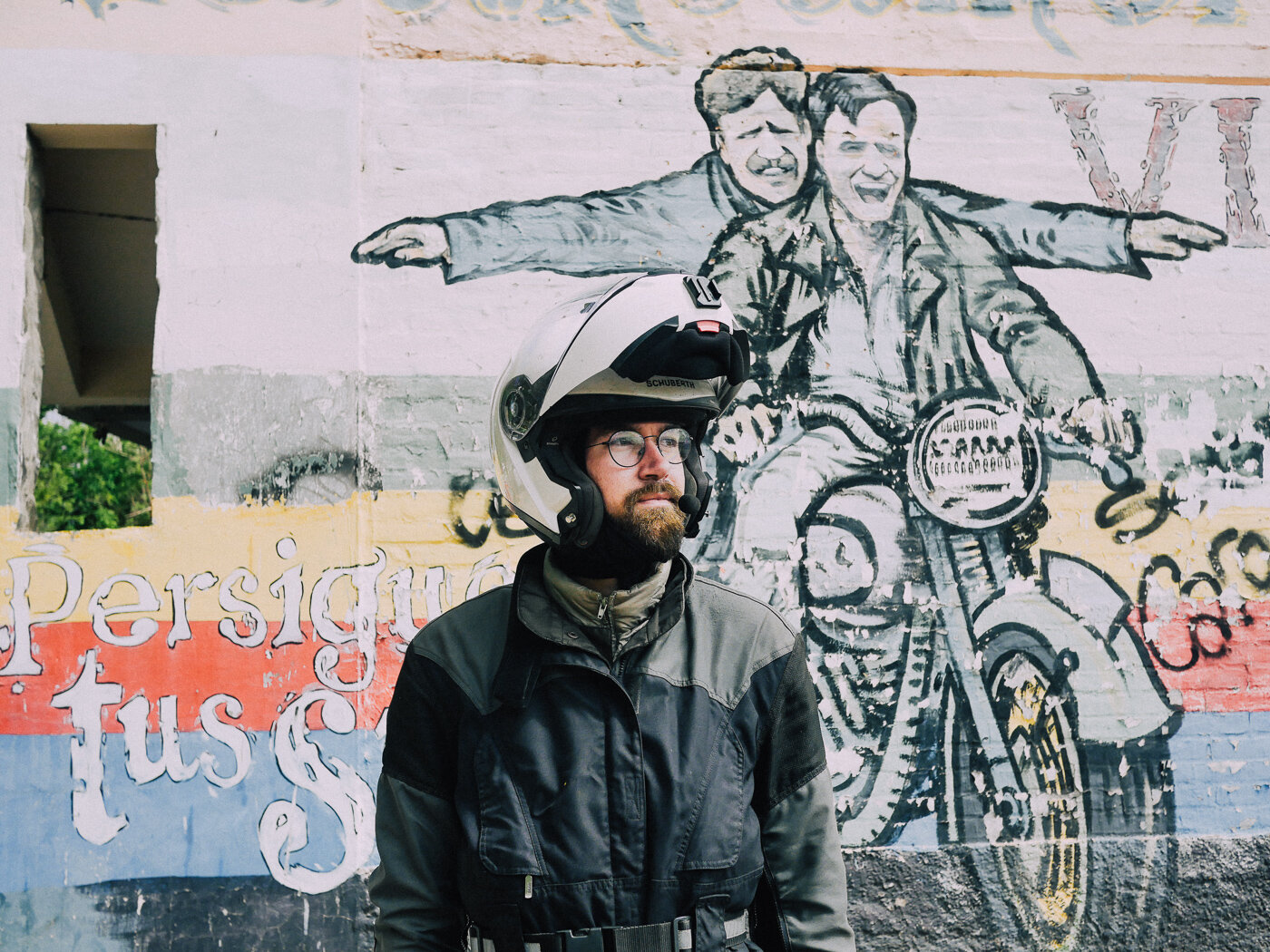
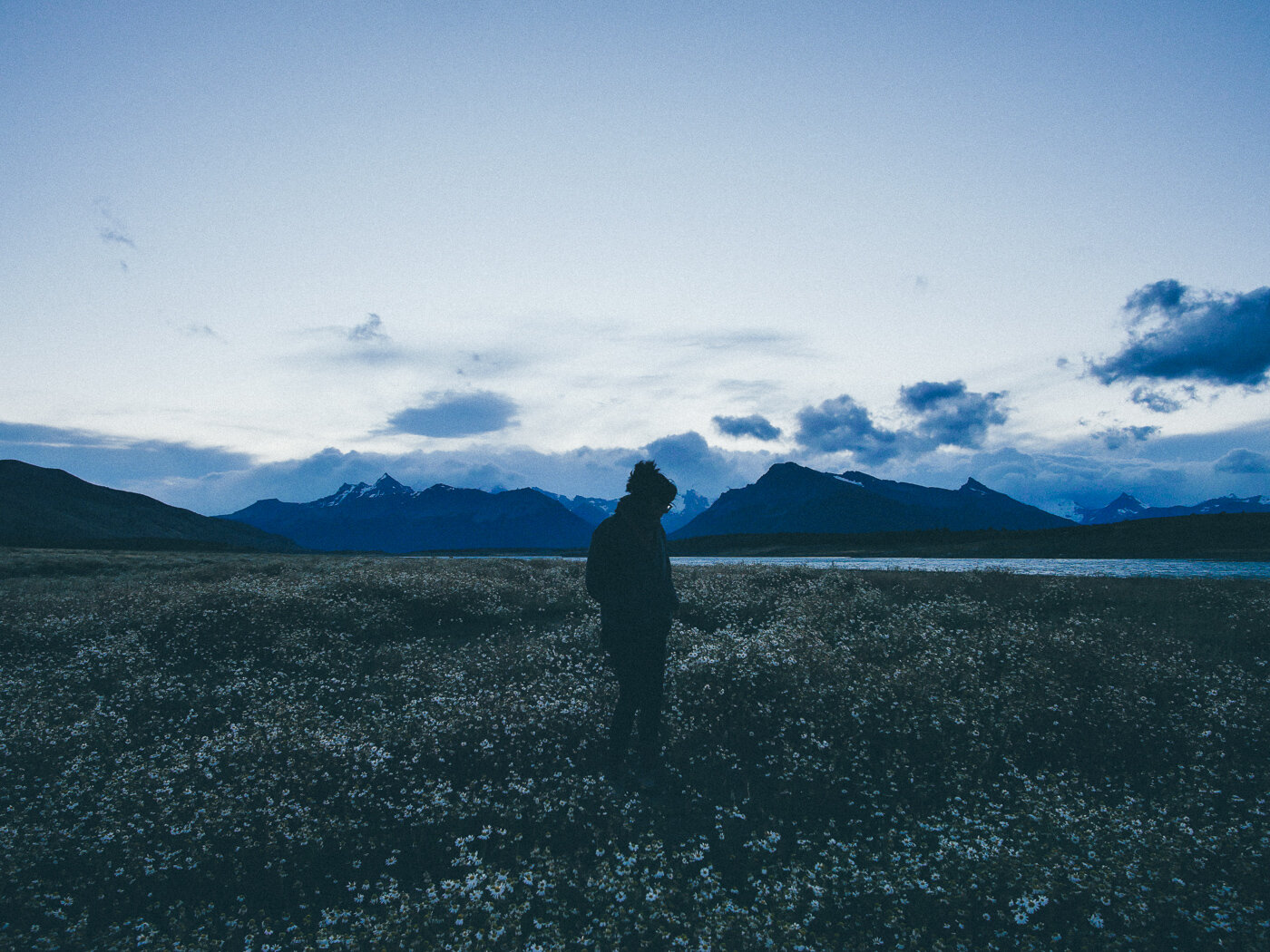
Suddenly, there was a chill in the air and dew glazing the grass and our tent in the mornings. It seemed like we had gone to bed in “Argentina” one night and woken up in “Patagonia” the next morning. The evening before, we had shared a bush camp with a young bicyclist from New Hampshire. He had, a few weeks prior, been held up in Chile by Mapuche tribesmen on horseback for unwittingly trespassing ancestral lands amid their standoff with the national government. As we rode out toward the nearest YPF, I regretted not having zipped up the ventilation panels of my jacket sleeves and having packed away my other layers. Gauchos wearing red neckerchiefs and riding enormous, gleaming, magnificent horses careened around the golden hillsides, and we could see deeply green, coniferous forests and mountains in the distance.

Parque National de Nahuel Huapi. Photo by Nathan Sharp
Suddenly, there were buses full of tourists on the highway. We had arrived in the province of Bariloche, a region famed for its pristine glacier-fed lakes and swanky ski resorts. A fashionably-dressed Chilean woman holding a Starbucks cup by the side of the road waved us down and offered us a sandwich of milanesa de res, a steak pounded thin, which was then breaded and fried. She and her husband were too full to eat it and were about to head back into Chile, whose border lay on the opposite shore of the lake. The sandwich, with sliced tomatoes, was serious agricultural contraband.
They serve too much food in Argentina! she lamented.
Waste not want not—we accepted the free lunch and soon after, posed for several photo ops with other tourists who were eager to shake our hands and share our accomplishment in having reached this territorial milestone after so many months. It was a milestone which we hadn’t realized we had unlocked until arriving there, and we hadn’t yet meaningfully considered its symbolism. While Tierra del Fuego and Ushuaia still lay hundred of miles away, it seemed our Beginning of the End—the most northerly of the most southerly we were going to get on this trip. It was too beautiful to feel too conflicted, though. The stillness of the lake flashed in the sun, and the air crackled with the explosions of millions of seed pods hanging from the shrubbery on the shoreline as the morning dew steamed away. We didn’t know what the pods were, but happily named them “poppin’ beans”. We celebrated with oranges, the salvaged sandwich, and a deliciously cold swim in the waters of Lago Nahuel Huapi.
✻

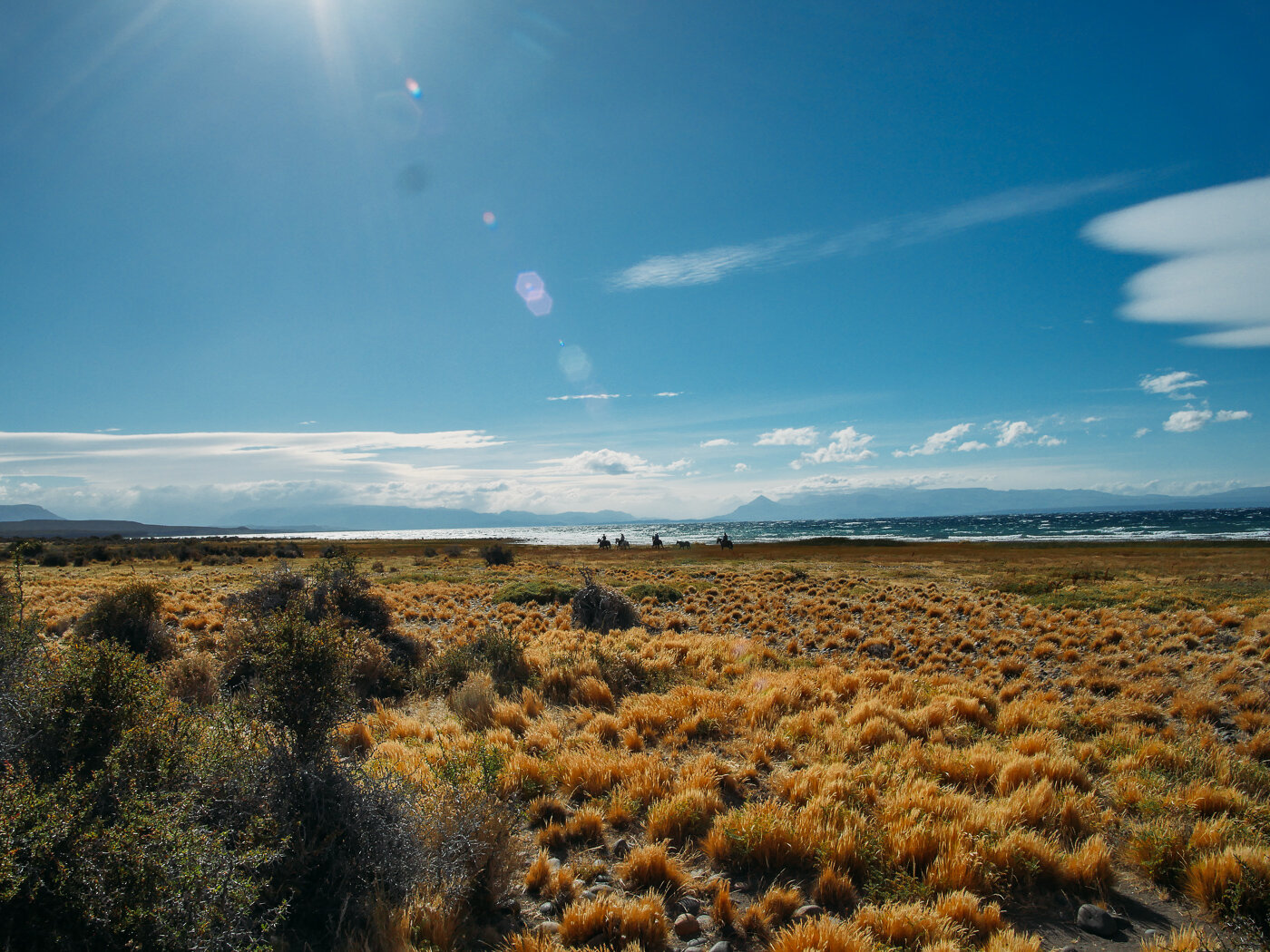
Pampa, pampa, pampa. Photo by Diana Juárez.
Thus far, the landscape hadn’t felt otherworldly, as other places had. Patagonia Argentina was often beautiful and frequently different than our home, but we didn’t always feel like hardened adventurers as we moved through it. For, for all the horse fields we woke up in, where we had to worry about inhaling the recent outbreak of Hanta virus atomized by morning mists, we had the equal opportunity of a two-steak dinner, or a dozen empanadas, or espresso and pastries in the morning. In many ways, our travels through Patagonia felt like good ol' American summertime fun. And it was—just not in a ketchup-and-mustard sense or perceived in the language we had grown up with. We capitalized on the amenities offered by municipal camp grounds, which offered accommodation for a few dollars per person, safe parking, grills equipped for large quantities of meat, hot showers, WiFi, and electrical outlets. The countryside, the endlessly long pampa, was all consuming. Frequently, it was monotonous. But I wasn’t eager to get through it and get it over with. It made me feel free and uncomplicated. I suspected that Nathan, a Texas native, was somewhat familiar with the big-ness and openness of it, but the feeling was new to me. The plant life was low and scrub-like, except for the tall rows of narrow, vertically-inclined poplar trees that the colonizing Spaniards had imported for their resistance to the wind. Poplars were the only trees that thrived here, and they delineated and shielded the grounds of the old estancias and ranches. Reclining, dilapidated wagon wheels marked the estancia driveways, and property-defining fences stretched infinitely onward, enclosing land that appeared no different from wild places.
✻

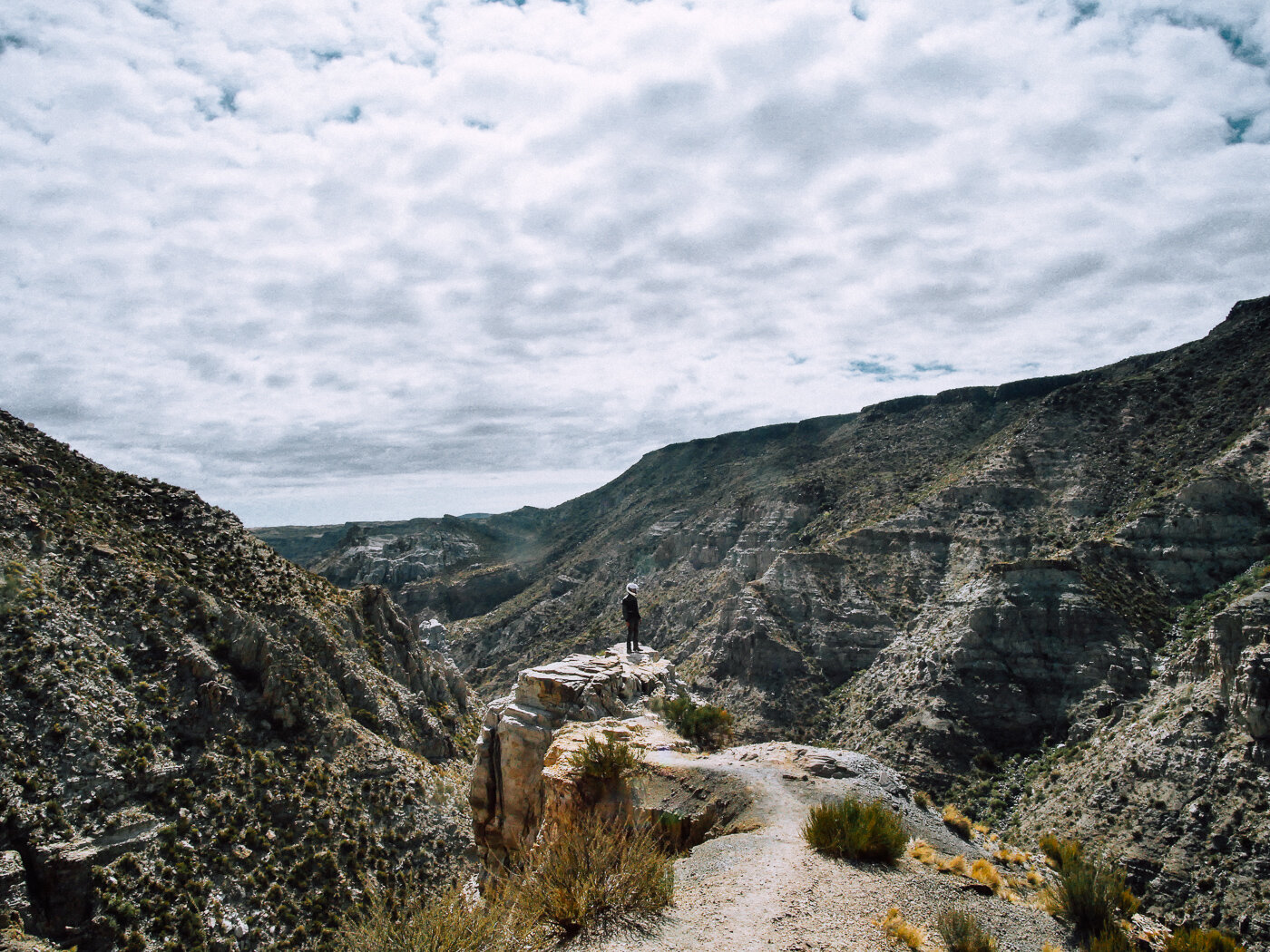
Canyon where La Cueva de Las Manos was discovered. Photo by Nathan Sharp
13,000 to 9,000 years ago, hunter gatherers travelled to what is know called La Cueva de las Manos, the Cave of the Hands. They’d come as a group and brought natural pigment and straws with them. Pressing their hands against the walls, they blew the pigment through the straws, leaving behind a speckled negative of their palms and fingers. They also painted guanaco hunting parties, a beetle-like, mythological deity, and symbols of the divine feminine—a few pregnant guanaco representing the phases of the moon, perhaps. Whole families, elevated individuals, one six-fingered person, a severed ñandu foot—all community members made their mark here. All were accounted for in the red, ochre, and black pigments blooming across the stone. Apart from these physical records, we don’t know much about who made them, really. But I liked to imagine them, whoever they were, turning away from the walls with one brightly-colored hand. I imagined the minerals, plants, insects, and fats harvested elsewhere and carried here, precisely for one purpose.
We were here.
And there we were, too.
When we ended the tour, we located the coordinates of a primitive campsite on iOverlander, which revealed itself to be a hillside completely exposed to the elements and to the view of the handful of residents of the hamlet of Bajo Caracoles. Evidently, it served as a dumping ground for barbecued guanaco carcasses and wrecked automobiles. Which is to say that it was lacking, even by our standards. So, we tried our luck at the clinic, the other spot recommended on the app. Several reviewers had noted that single clinician who worked there allowed travelers to stay in the unoccupied beds, since the village had only one inn that was only open during high season. We rang the doorbell, but the clinician never appeared. However, a helpful neighbor heard us calling and directed us down the road to a lean-to administered by the clinic’s groundskeeper, a man named Pablo.
Place our tent anywhere you like, he said, indicating various spots under the plastic corrugate roof held up by raw wooden posts. Pay whatever you think is fair.
The ground was cold, pebbly, and gray, and the sky, too, was gray; a far cry from the warm hues aspirated onto the walls of the canyon.

La Cueva de las Manos. Photo by Nathan Sharp
As we prepared a light meal of packaged soup mix and hot coffee on our camp stove, Pablo spoke at length on all subjects. More travelers showed up as the evening progressed and we commiserated about the winds that had pummeled us on the ride over. A cyclist from Belgium, also camping in the lean-to, said that he had had to walk his bike in the wind the whole day prior. One particular gust had lifted his bicycle completely off the ground and whirled it around a full 360 degrees. Pablo laughed and seemed to enjoy bemoaning the barren landscape of his current residence.
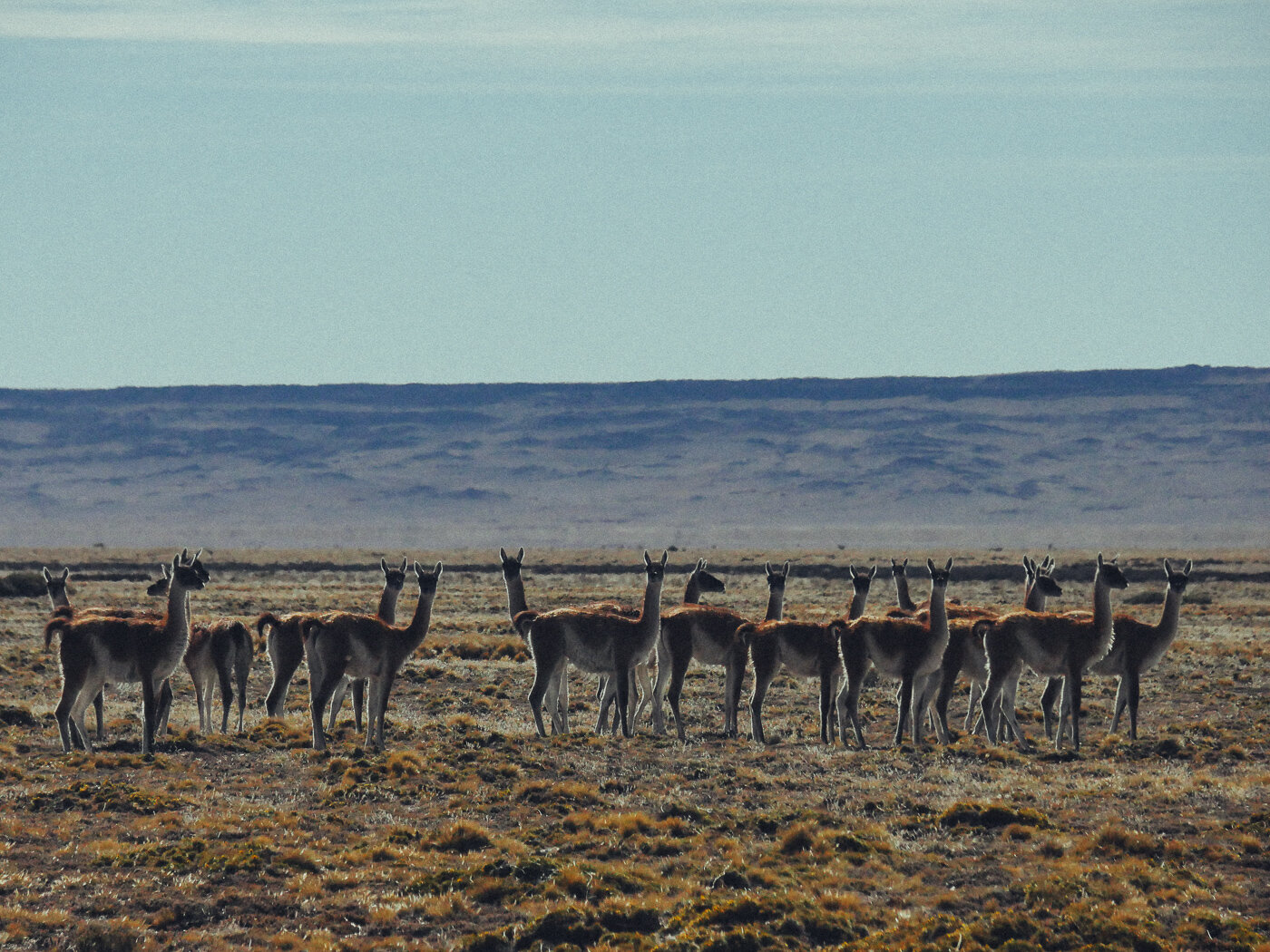
We wondered how Pablo had ended up here, so far from his sprawling, bustling home of Buenos Aires—so far from anything, really. He amused us with the difference between guanaco and vicuña—that the latter were like the fairer sex, slender, untouchable, and their fine wool never besmirched. The guanaco, despite bearing nearly identical coloring and markings, were the grungy, flea-ridden, belching, and wind-breaking equivalent.
The next morning, Pablo seemed sad to see everyone go. His smile, peppered with missing teeth, seemed to fade quickly, unlike the evening before.
Just remember that you’ve made it this far because God is watching over you, he told us. The next 90 kilometers will be the worst!
That day, however, the winds were in our favor. We had heard that the ripio, the large chunks of loose gravel concealing deeply rutted ground, would feel like slippery marbles strewn on top of greasy banana peels and black ice. Indeed, it was challenging terrain, and I could hear Nathan breathing heavily over the intercom over my own held breath. But, by God, he kept us upright for each of the 90 kilometers. I never had to dismount and walk once—except once, by choice, to follow a meandering armadillo.
From a distance, the landscape appeared gray. But upon closer examination, it was a mottle of frosty sagebrush, yellow and periwinkle wildflowers, and golden coiron grass. We scrambled up to the top of some huge, abandoned concrete blocks with twisted rebar sprouting out of them towards the sky. From there, we spotted two figures on horseback approaching us and two dogs trotting along behind them. We waved at the gauchos, their tell-tale berets and slip-on shoes visible as they came nearer. Then, the second rider turned his horse sharply towards us, and from our concrete and rebar perch, we began to wonder if we were inadvertently loitering on private land. We penitently slipped down to the ground. But once the gaucho’s face came into clear view, we could see that he was smiling from ear to ear.
Good evening! I’m not working today. I’m just out for a stroll! he called from his mount.

The gaucho. Photo by Nathan Sharp
Oh! That’s nice, I said, tickled by his exuberance. Truly, his countenance had to be the most handsome we had encountered in all the Americas, with his flowing, salt-and-pepper, chin-length hair and finely-weathered face. He looked to be about sixty years old and like the star of an old film. His name was Mauro, and he was not from this region, but from Chubut Province of northern Patagonia. Nathan and I introduced ourselves and attempted to chat.
We passed through Chubut a few days ago! I said, pleased with myself to recognize the place name. He was pleased to hear it. But a few—more than a few—of the finer points of the rest of the conversation were lost on us. Not only was his accent wildly different from what we had previously encountered, but his inebriated speech gave us even greater challenge.
You should take a photo of me, he insisted. But not for pay! No, not for pay!
I said that we would be honored. The horse snorted and stomped and displayed his general distaste for the interaction. As we watched Mauro gesticulate and sway grandly in his saddle, while expounding on something I didn’t quite catch, I marveled at his ability to maintain his mount. Only someone who had lived their whole life on the back of a horse could keep their balance like that, I thought.
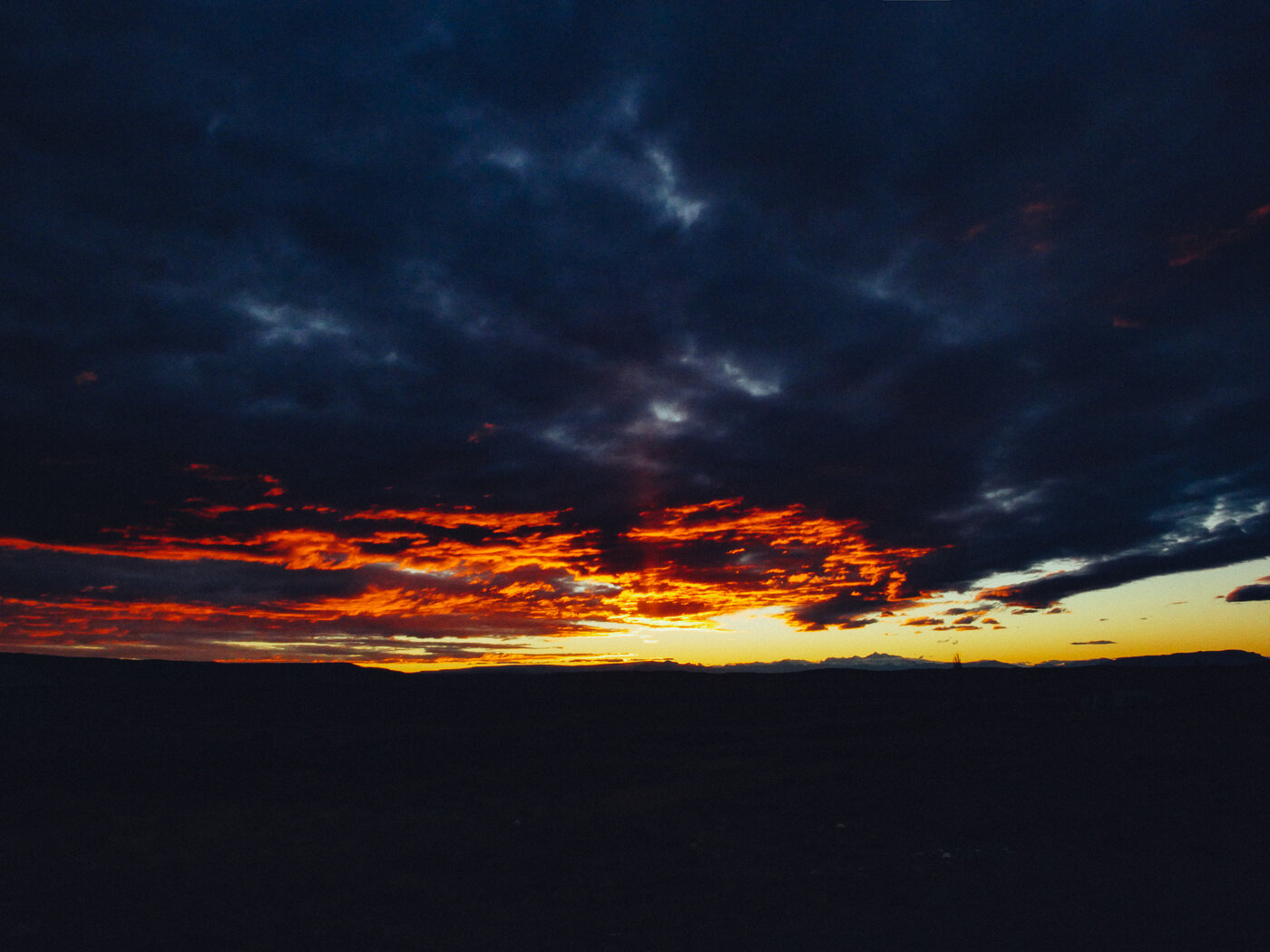
The other rider, who never did approach, waited patiently at the side of the road. The folds and wrinkles in the clouds were gathering dimension and the sky was ripening with dramatic color. We needed to get going. Nathan started the bike again and we said goodbye to Mauro.
✻

Finally reunited with pavement on Ruta 40. Photo by Diana Juárez
Jurel. The putrid gift that kept on giving. Having first popped open a can of it in Peru, we had since learned to double check the labels on the cans that bodega clerks retrieved for us from their shelves, as we rambled off our grocery lists to them. Canned tuna, even chunk light, often cost a whopping $4 to $5 USD per can and could be difficult to find outside of mega-market shopping experiences in South America. Clerks usually used the terms jurel and tuna, atún, interchangeably and usually assumed that jurel, a whole dollar or two cheaper, was our preference.
But jurel was not just a brand of tuna. Oh no. Rather, jurel was a food byproduct marketed for its rich nutritional and economic value. It was comprised of every last, remaining scrap of yellowfin tuna—whatever flesh that might have clung to the lips and to the backsides of the eyeballs and to the smallest bones, and whatever interstitial goo could be scraped from between the scales, probably, ground to a porridge-like consistency and suspended in soybean oil. Sometimes, as on the first occasion—after an exceptionally long day of riding through Cañon del Pato, throughout which we had steeled ourselves onward with the promise of two cans of jurel and a packet of saltine crackers stashed in my backpack—it was seasoned with a touch of oregano and two large, threatening aluminum shards.
Por favor, no Jurel, I would quickly blurt during all future bodega trips, if, upon asking what brands they carried, the clerk’s hand automatically shot out toward a stack of jurel. The food product became a running joke between Nathan and me, pronounced not hoo-rél, as it was properly pronounced in Spanish, but Jurl! with a j as in jury and url as in girl. It sometimes signified an imaginary mischief maker who had followed us from Sausalito, hiding pertinent belongings and destroying our tent flap zippers. Sometimes, it was the name we called each other after making silly mistakes. And, at other times, it was the name of a fictional, future companion whom we might find sitting with us on the porch, in the twilight of our golden years, whom we would shout to from the other side of a fictional screen door. Jurrrl! we would drawl, from Peru and southward, at nobody. (As with many long-running gags, I suppose, you kind of had to be there.)

Municipal campsites were abundant and affordable. Photo by Diana Juárez
Nevertheless, we celebrated our completion of the hardest stretch of Ruta 40 with a night in a municipal campsite in of the town of Tres Lagos. On our way into this single-street, two-block town, we spied a bodega that Nathan would later returned to on his own, while I set up camp. I had requested tuna and would take over dinner preparations once he returned with the fixings. On the rough wooden picnic table, I cut the lids of the cans open with my pocket knife and began tipping out the oil into the provided trash receptacle. A finely ground fish pulp slid out with the oil and a familiar, pungent odor slithered into my nostrils. My heart sunk. I quickly scanned the label. It didn’t say Jurel. Puzzled, I pried the lid off completely. But neither my nose nor my eyes could deceive me, no matter what the label said. Jurel by any other name would smell as offensive. And while we generally embraced making do with whatever we had to eat, I knew it would be in vain that might I attempt to press any more oil out of the fish matter.
Nathan, I said, holding the contents of the can out for his examination. I can’t eat this tonight. I just can’t. Fortunately for me, Nathan was in no mood either, and he headed straight back to the store for absolutely anything, anything, besides jurel. In a moment, a rickety, starving, old dog came quivering toward our campsite. I snatched one of the cans off the table and gently approached him. He wagged his tail but shied away from me, cowering his scarred head. One meal wouldn’t do much for the poor, old thing, I knew, but I set the can down anyway. The dog carefully approached the can, sniffed, and jerked his head away. And then, seemingly upon reasoning and consideration, he lowered his head and gingerly began to lap up the soft paste. An orange cat, in somewhat pluckier condition, also trotted out from the surrounding brush. It had noticed the exchange and began meowing loudly at me for my lack of inclusion. So, I set the second can in front of him. He refused.
✻
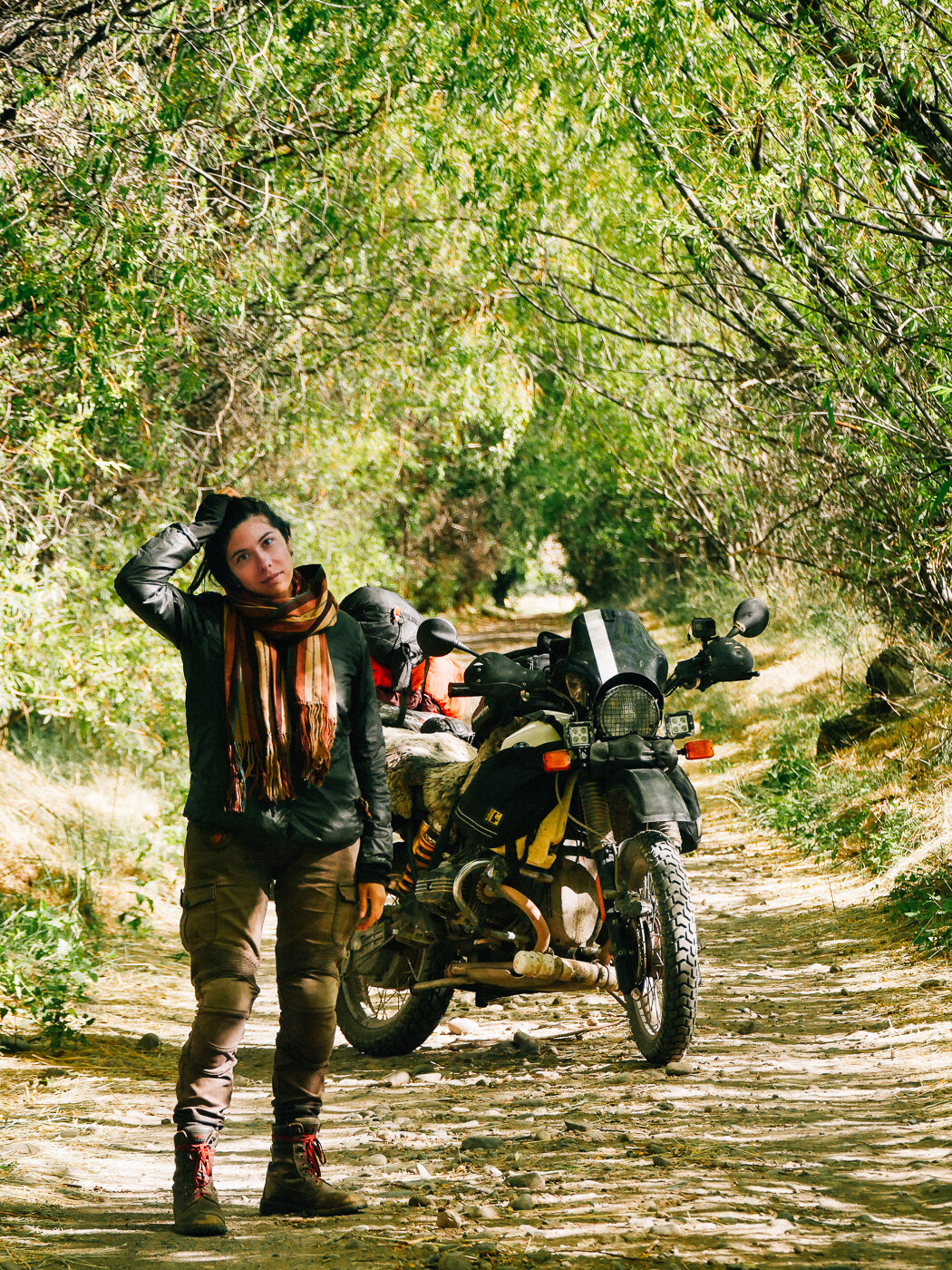
Mud was doable. Rain was doable. Riding in the heat, in the cold, through Central American traffic, and with gastrointestinal complaints, was all doable. But I hate riding in wind. I hate it more than wobbling through loose sand and slip-sliding over slick, wet, algae-covered pavement. We had dreadful recollections of riding through powerful gusts in Oaxaca, Mexico, and it was the factor we had regarded with the most trepidation upon leaving Bogotá. Nathan had read somewhere that rotating a leg into the wind in the direction from which it’s blowing, like a sail, could help stabilize the bike and minimize the feeling of being blown off course. Of course, with our substantial pile of gear and and two riders, we were already sail-like in the worst sense. And while I didn’t have much room to stick out my own leg because of the panniers and the bags strapped on top of them, I did the best I could and learned also to brace my hand on my hip against the wind. I’m not sure if this had any effect at all, but I did what I could to feel even the tiniest bit more in control. Friends we had met, who had started in the south and were headed north, recommended that we steel our torsos, shoulders, and necks as much as possible; to accelerate when large trucks passed us and created additional gusts with their bulk; and, when the wind promised to be terrible, to wait for more favorable conditions.
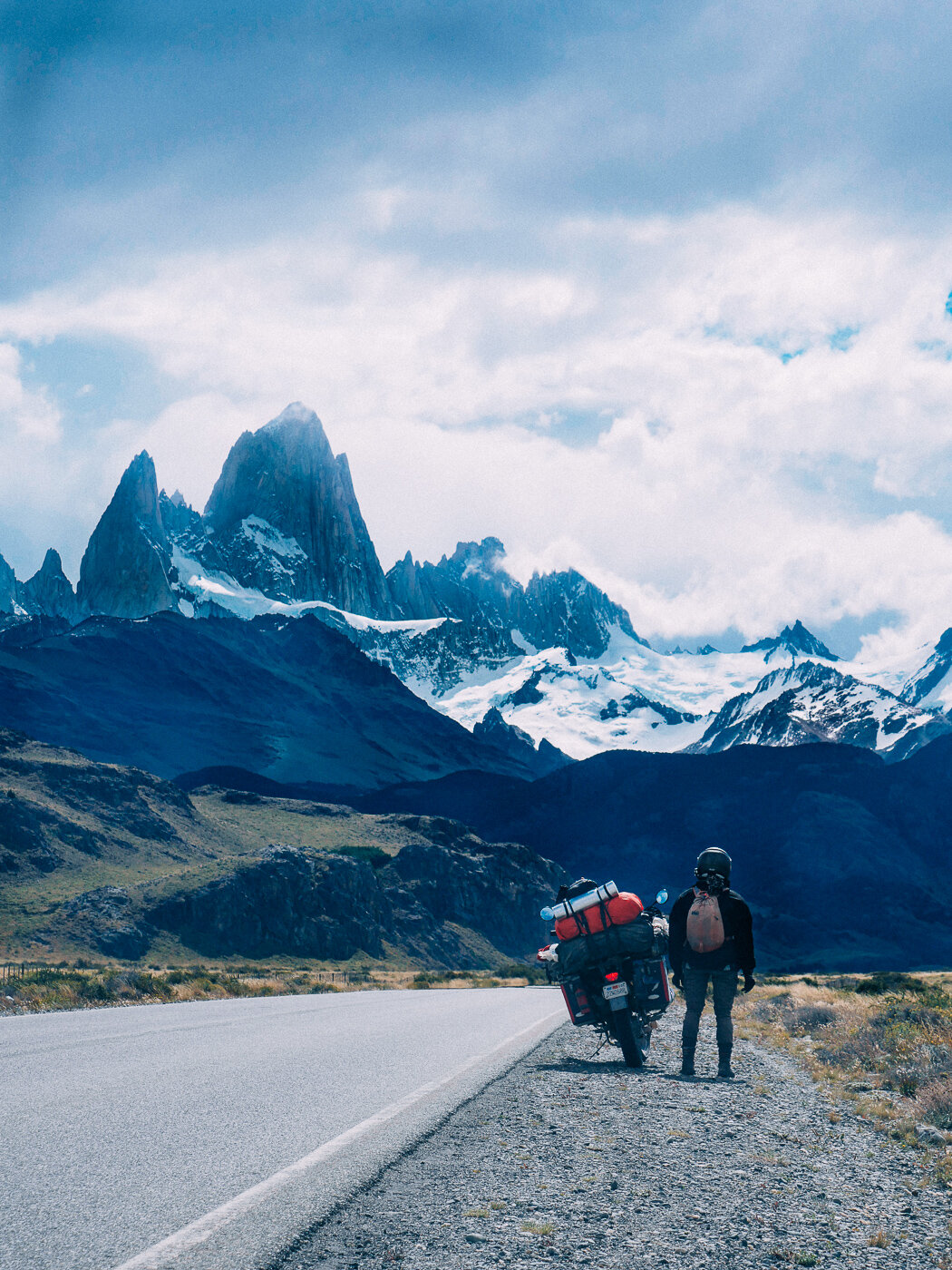
One day, we were headed to the town of El Chalten, the trekking capital of Argentina, located at the edge of the Southern Patagonian Ice Field and at the bases of Cerro Fitzroy and Cerro Torre. We climbed off the bike many times to behold the breathtaking mountains of Southern Patagonia as they rose to meet us. They seemed very peculiar, like gentle, majestic, sloping mountains that had been strip-mined at a certain height and upon which jagged spires had been haphazardly deposited on top, the fault lines of the jagged top halves running in completely different directions from the sloping bottom halves. They appeared as if the lower, denser-looking portions of the mountains were now hosts to haphazard parasite mountains. Fitzroy glowered in the distance, the slate-grey of its stone almost navy blue against the grey sky; a foreboding, scowling figure in a moody, fantasy realm. And then we spotted the glaciers; the first of both of our lives. These were contained within various peaks and literally seemed to glow. Again, as with the Uyuni Salt Flats, it was amazing that something so familiar as ice could seem so foreign, enchanting, and mysterious in such larger-than-life proportions.
When we arrived in El Chalten, we visited the tourist information center for information on the upcoming weather conditions. Due to the frequently inclement weather of El Chalten, the tourist center provides wind predictions for several days at a time. While we had an app called “Windy” that we could use offline, we had no context for interpreting the data. For example, on the way to El Chalten, we knew that we had ridden through 90 km per hour winds. But we had heard that the winds of this region were damn near impossible and that they had knocked over plenty of riders with more experience than us. How much worse they could possibly get? We were anxious to know.
80km—100 km, the last category of the chart posted in the visitors center read. Violent Storm. Not much worse, as it turns out.
✻

Perito Moreno glacier. Photo by Diana Juárez
Valentines Day found us in the town of Calafate, the springboard for visiting the Perito Moreno glacier, one of the few glaciers in the world still advancing. There, we splurged on a hotel room with a private bathroom, a feast at a local parilla, and a bottle of wine. We enjoyed a bath in a real bathtub and came up with lists of the five things we loved most about each other. We strolled the sidewalks, enjoyed yet another cone of Grido ice cream, and watched vacationers discover a rather charming, if packaged, version of the mythical Patagonia.

Serving up leftover empanadas and legs in Parque Nacional los Glaciares! Photo by Diana Juárez
The next day, we beheld the bubblegum blue of the glacier. We felt numinous and expansive in its presence—had we encountered any other blues in nature which could match its intensity? We counted off the resplendent quetzal and the blue morphos butterflies of Central America, and the molted papagayo feathers we found in Yasuní, the protected territory of Ecuador’s Amazon forest. Yes, there were a few solid contenders. But what a marvelous mental rolodex to carry around! The jagged ice field of the glacier’s surface looked like frozen, spiny treetops, and the roar of its calving—the shearing off of great chunks of it into the lake as it advanced—was like something biblical, like the splitting of rocks and the mountains made low.
We ended the day on the shores of Lago Argentina, within Parque Nacional los Glaciares, strolling hand in hand and watching the dark ears of hares flicker through tall grasses. I stooped to collect a few, downy, speckled goose feathers. We were joyful and felt close to each other, but we walked slowly. Ushuaia was now days away. Who would we be once we returned home? Would we be so satisfied with things like the lightness of feathers? With the color blue?
✻

Perito Moreno glacier. Photo by Nathan Sharp
When we set out for this trip, I was not prepared for the relationships I would develop with the elements or for the dominance they would claim over my perceptions and memory. The wind; the woods; the fires; the metals; the water. I was lightly-versed in their significances within various Eastern systems, New Ageisms, and Pre-Columbian cosmologies. But I wasn’t prepared for how I would move beyond simply being aware of these traditional or esoteric conventions. I wasn’t aware of how relevant they would become as symbols, nor of how vitally important symbols would become to my own sense of being alive. Symbolism: not just one of many possible lenses for interpretation, an intellectual exercise, but a route towards understanding that has become integral to discovering truths that reside deep within myself. The kinds of truths that reside within everyone, but that can sometimes seem so fickle and dependent upon circumstance as to lie beyond our knowing.
The winds, for example, that steal our sleep and stiffen our necks and that have followed us all the way here. The winds of change. How I had changed so much of the exterior face of my life, yet could see no change in myself. The glaciers, the lakes, the seas, the calderas, the rain. The freeze or flow of water. My resistance or my surrender. The irons and the coppers and all the minerals deep within the earth and in the mountains and in my blood and in my food. Beneath my feet and deeper beneath the ground. The light and destruction and forceful alchemy of the fire and smoke that filled the cabin of our little fish boat when we lived downwind of burning Sonoma county. Every smoldering failure and every chance I’ve had to begin again. The pines, the palms, the ceibas, and the vines that swoop down from light-brindled canopies. The fertile darkness harbored within each forest, where we’ve heard frog-mouthed nightjar birds cry out like madwomen, in which growth still, somehow, strives toward the sun. The darkness in which I’ve discovered that all I really want is to bloom and grow. No wonder that for so many peoples the lines of life are shaped like a tree and that Jesus gave up his life on bits of one and that Buddha saw all of eternity while sitting beneath one. No wonder we wonder.
✻
We arrived in Rio Gallegos the day after. The land was grey and featureless, and our bodied registered that we had been riding every day since we had departed Mendoza. We had also been wearing our standard “Peru” getups, which consisted of as many layers of clothing as possible, because we had decided against buying heated riding gear. I wore legging under my motorcycle jeans, two pairs of knee-length socks, three shirts, a down jacket, a motorcycle jacket, my FroggTogg rain jacket and rain pants, a bandana around my neck, a headwrap, a scarf, and my winter gloves. Nathan wore another version of the same. The gas stations of Patagonia, we had found, were fewer and farther between, not nearly as luxe as in the rest of Argentina, and the wind and the constant, cold drizzle were wearing on us. Our necks creaked and our shoulders ached, and we resigned our spoiled selves to pint-sized cups of instant nescafe that dribbled from automatic machines at the push of a button. If the grey, bleak landscape outside of Rio Gallegos wouldn’t keep us awake, then the caffeine would.
We were sure we’d reach Ushuaia the day after and were pensive as we pulled into a municipal camp ground. Then, a black Harley Davidson motorcycle with a rolled-up Mexican blanket strapped to the handlebars pulled into the gates. It was Kito, who had ridden his Harley around Spain, Africa, and South America for the last two years. We invited him to share our steak cook out, on the ubiquitous concrete grills. I’ll be back with more beef! he yelled back.
As we cooked steaks and whole potatoes, the rain poured down, and there was nothing overhead to shield us from it. But we didn’t care. We ate our meal with our hands and swapped stories back and forth from the last several months of our lives. Kito revealed that he had been carrying a bottle of handmade mezcal in his bag since the day he left Mexico. After two years on the road, he was missing home, his street tacos, his tequila, and watching life play out in town squares. With every drop of the bike on difficult terrain, and with every mini-disaster of his trip, his mind had leapt to the bottle of mezcal. Had it shattered? Didn’t he deserve just a sip for whatever he’d just been through? But he never did open it. Instead, he would stoically remind himself of how special it would be to toast his arrival in Ushuaia with this smoky, complex hallmark of Mexican culture.
I’d like to share a mezcal toast with you guys when we get to Ushuaia. He said. His wet hair was plastered to his face. As was ours. The night air was growing cold. I have a good feeling about it.